 |
| Double Cross |
Title: Double Cross
Author: Ben Macintyre
Year: 2012
Genre: Non-Fiction, History
Hi guys, so for this months review I have read Double Cross by Ben Macintyre which is one of the strangest and fascinating spy stories I have ever read, mainly because all of it is true. I found the book in my local library around the time of the 75th anniversary of the D-Day landings back in June and after a few weeks I decided to borrow it to find out more.
The book focuses on the 'Double Cross System' used by MI5 during the war and in particular how the system was used to mislead Nazi Germany that the Allies were going to launch an invasion in two places, at the Pas De Calais and Norway, not the Normandy beaches where the invasion took place.
The book tells the stories of Dusan "Dusko" Popov - a Serbian playboy, Roman Czerniawski, a tiny Polish fighter pilot, Lily Sergeyev, a hysterical Frenchwoman with a massive love for her dog Babs, Juan Pujol Garcia, an imaginative Spaniard with a diploma in chicken farming and Elvira de la Fuente Chaudoir, a Peruvian bisexual playgirl or as they were known by the agent codenames, Tricycle, Brutus, Treasure, Garbo and Bronx respectively. The deception involved every branch of allied wartime intelligence from the Bletchley Park codebreakers - known as "Most Secret Sources" in the book, MI5 and MI6 to the FBI and the French Resistance.
I am a massive fan of spy stories and thrillers, having read and reviewed quite a few of them for this blog but the most amazing thing about this particular story is, other than Bronx and Tricycle, none of the double agents fit the Hollywood James Bond or Jason Bourne stereotype at all, most of them are ordinary people who you would pass on the street. However how they managed to deceive the German military intelligence, known as the Abwehr is nothing short of extraordinary.
There are quite a few moments in the book that were completely incredulous and probably too many to mention. For instance, Garbo's story started out with him trying to make contact with MI5 who didn't want him, he then turned to the Germans thinking he could become a double agent and initially he was refused before finally being accepted by them, his role was then to travel to neutral Lisbon in Portugal and try to smuggle himself to Britain. However instead for two years he stayed in Lisbon and used the local library archives to make up his reports to the Abwehr and used his own imagination to fill in the blanks. Being British myself the report he wrote to the Germans that Glaswegian men "would do anything for a litre of wine" made me chuckle. Furthermore when the British eventually did notice him and he became a double agent, with the help of his handler Tomas Harris, they built up an entirely fake network of agents, such as a group of Welsh anti-Semites who were keen for the Nazis to win the war so they could support the new regime.
Further on in the story, Tricycle is asked by his German handlers to set up a spy network in America so he goes over to work with the FBI but because at the time they were mistrustful of double agents they largely stopped him from doing anything, so Tricycle ran up huge debts on their payroll which MI5 were still sorting out 3 years after the war. However, Tricycle did come up with an ingenious scheme where a middleman in London could pretend to pay the German spy network money and be reimbursed by the Germans paying money into one of his bank accounts in another country which MI5 could simply pocket, the result being that the Germans would in effect be paying the Double Cross system, this resulted in it not only being self-financing but also profitable with the Germans paying Britain "£85,000" - the equivalent of £4.5 million today. Furthermore Tricycle's German handlers were slicing off money owed to him to line their own pockets which meant later on in the war they were more susceptible to the deception as they didn't want to admit what they had been doing.
The most shocking and bizarre part of the story for me though was Lily Sergeyev and her dog. Basically Lily enlisted herself as a German spy with the intention of working for the British but for a long time she was living in Paris as her German handler was more interested in his mistresses then helping the Nazis win the war. Eventually he did send her to Britain and she immediately contacted the British to work as a double agent but one of he requests was to allow her do, Babs, to come with her but British quarantine laws said any dog must be kept in quarantine for six months before being allowed to come to Britain (in fact this law still existed in Britain until 2011 where it was shortened to three weeks).
The British said they would do their best to bring the dog over which Lily took as a promise they would but unfortunately the dog died in Gibraltar, Lily was furious and seeked revenge and when she was asked by the Germans to collect her wireless transmitter she was given a "control signal" - an imperceptible signal that a German agent could give when transmitting to tell the Germans they were under British control. However she did not divulge this information to her British handlers, instead sitting on the secret for the months leading up to D Day. She did eventually tell ehr handlers she had a control signal but did not tell them what it was, meaning the British had to take a leap of faith that she hadn't told the Germans she was a double agent. If she had then all of her traffic would be read "in reverse" i.e. if she said the British would attack the Pas de Calais, then the Germans would realise they weren't and it was a diversion.
Yet another incredible part of the story was the fact MI5 had a Soviet mole in its midst, Anthony Blunt who was feeding back to the Soviet Union what the British were doing (a fact that was only discovered much later in 1979). This could in turn mean that if a German agent was in the Soviet Union the truth could've ended up back in Berlin anyway (it isn't known if there was an agent in Russia working for the Germans). However the Soviet's themselves believed their agents reports were too good to be true so they believed their agent had been turned by the British so they read his reports "in reverse" like the example above, which in fact would've strengthened any deception in Germany as the Nazi moles would be passing on this information instead of what was originally sent.
Overall this book is extremely enjoyable and fascinating and shows how heroes can turn up in the most unlikely places and also how sheer good fortune and nerve played a key role in one of the pivotal moments of the Second World War, and indeed world history. I would definitely recommend this book to anyone who is a fan of spy stories or has an interest in the war.
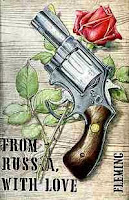 |
| From Russia With Love |
Name: From Russia With Love
Author: Ian Fleming
Year: 1957
Genre: Spy, Thriller
For this week's classic corner review, I will be continuing the recent theme of reviews of the James Bond novels with the review of the fifth novel in the series, From Russia With Love.
Plot
In the opening chapter of the novel in what is quite a bizarre scene a masseuse has come along to visit a Englishman at his apartment to give him a massage. We quickly learn however that this is behind the Iron Curtain in the Soviet Union and that this Englishman is in fact one of the main killing machines for SMERSH - Russia's secret police and that he has been summoned to take on a new assignment.
It appears that the heads of state in Russia have become increasingly angry at the poor performance of Russia's secret service in helping to spread Communism throughout the West and undermine Western powers so they set them the task of creating a konspiratsia that would be completely shocking to the secret services and would also cause a huge public scandal.
The chief strategist Kronsteen, comes up with a clever solution. His aim is to make it appear that a young Russian woman has apparently fallen in love with a Western spy after seeing their file, and is willing to steal the Spektor machine for the opposition, one of the Soviet Union's greatest secret weapons, provided that this spy will give her safe passage to the West. The secret service scandal would be the machine doesn't work and when the female spy and the male spy are found dead shortly afterwards, a film of them making love would cause a huge public scandal.
Following the input of SMERSH's head of operations, Rosa Klebb, it is decided the British agent chosen to have their reputation smeared by the conspiracy is James Bond after he killed some of SMERSH's key operatives (in Casino Royale, Live and Let Die and Moonraker). The woman chosen is the beautiful Tatiana Romanova and the location Istanbul.
Following this the action shifts to Britain where Bond is called into M's office and is sent to Istanbul to investigate Romanova's claim's and to retrieve the Specktor machine. However will he unravel the conspiracy in time or is he walking blindly into such a perfectly devised honeytrap.
Thoughts
On reading From Russia With Love, one of the first things that struck me is how Fleming once again changed the structure of the novel. In both of the previous two entries in the series, Fleming pretty much made us see the entire plotline through Bond's eyes as he investigates the villain's plot. However in this novel the entire first section takes place completely in Russia (in fact Bond only enters the novel at around the 10th chapter). This unusual tack means that the reader is more or less omniscient in the novel long before Bond gets to the same place. In some respects this may put off some readers who like to be kept guessing but it does make the book more readable as you can see Bond is walking blindly into the traps set out for him by the Russians.
The novel is once again very glossy and glamorous and features many of the usual elements to keep fans happy - the exotic location of Istanbul (and the exciting final chapters on the luxurious Orient Express), the action sequences (special mention again to the Orient Express and also the chapter set at the gypsy camp), a beautiful leading lady in Tatiana Romanova - it all once again comes together to make a very taught, complex thriller novel.
Also as a little side note for people who are fans of the 1963 movie adaption (and having only saw it again myself recently) the novel is one of the more accurate adaptions with most of the material having made it from the book onto the silver screen. This is probably because unlike the previous three novels which were only adapted on film some years after they were initially published - From Russia With Love was only 6 years old when it was filmed with Sean Connery so many of the elements would still have been very relevant.
Also, unlike the previous entries in the series, the novel actually ends on a cliffhanger and doesn't have a completely closed ending in the same way as the previous two entries, how that is picked up in the next entry in the series remains to be seen (though you know by now I won't actually reveal the cliffhanger here, right?).
There are however a couple of things which will grate some readers. In a similar way to the previous entry in the series, Diamonds Are Forever with Wint and Kidd being the two villains in a homosexual relationship, there is a massive suggestion once again that Rosa Klebb is in fact a lesbian when she comes on to Romanova in one of the earlier chapters. This may have been coincidence but it may grate that the villains in the last two novels are both homosexual so there seems to be the start of a theme here.
Also the novel frustratingly takes another back step with its leading lady with Tatiana probably being on a similar par in terms of usefulness to the plot as Live and Let Die's Solitaire i.e. not very. This was a little frustrating for me after Tiffany Case and Gala Brand elevated the female presence in the novels beyond mere damsel's in distress for Bond to rescue. This does provide insight into Bond's character however in his protective instincts over seemingly vulnerable women and probably suits the plot of the conspiracy more than a character like Tiffany Case or Gala Brand would.
Verdict
From Russia With Love is a searing spy thriller and a worthy entry into the Bond series.
Availability
At the time of writing, the book is available on Amazon for £8.99 here . This link is an affiliate link, and I may receive a commission from the sale though this will not affect the price for you.
Let me know your thoughts in the comments below.
 |
| Diamonds Are Forever |
Name: Diamonds Are Forever
Author: Ian Fleming
Year: 1956
Genre: Spy
For this week's review I shall be reviewing Diamonds Are Forever, the fourth James Bond novel written by Ian Fleming.
Plot
The novel begins in South Africa where a dentist employed at the diamond mines in Africa near Sierra Leone is meeting a man in the desert as part of a wider criminal conspiracy to smuggle diamonds.
A few weeks later in London, the police have arrested a key link in this pipeline - a man named Peter Franks when M decides to let Bond take Franks' place in the pipeline - with the aim of following the pipeline to it's source and destroying it. It is believed the source lies in America with the Spangled Mob - one of the USA's biggest mobster gangs who are using the diamonds to make money to finance it's criminal activities - including selling the diamonds as jewelry at the House of Diamonds jewelers back in London.
Bond meets Franks handler, the beautiful Tiffany Case and manages to successfully smuggle the diamonds out of London and into America. There he meets the Spangled Mob and tries to infiltrate the gang further - whilst being led to some of America's glamorous gambling mecca's - including the glittering lights of Las Vegas.
However as Bond plays with fire in the gang, will he eventually get his fingers burnt.....
Thoughts
This review follows on from my review last month of the third James Bond novel, Moonraker and once again Ian Fleming as created a brilliant thriller novel.
In many ways I found Diamonds Are Forever to be much more relevant to a modern audience then all of the previous three entries to the series. In this adventure Bond is not dealing with the defunct Soviet Union, but a gang of criminals, a villain which we are all aware of and can believe in and Fleming takes this very gritty setting and adds in all the traditional elements of Bond:- the glamorous locations, action, espionage etc..
The book moves along at a very fast pace and it is interesting to see Bond operate on the inside of the gang, slowly increasing his status there before he can stab them in the back and the novel has its fair share of twist and turns to keep you reading. Also in a pleasing touch for longstanding fans of the series, Bond's American counterpart Felix Leiter, a character last seen in Live and Let Die also makes an appearance within this novel.
Also once again, Fleming has created a strong female lead in Tiffany Case. In many ways Tiffany is a stronger female character than her predecessor Gala Brand, even rescuing Bond from the hands of the villains at one stage of the novel so she doesn't fulfill the typical "damsel in distress" seen in some of the earlier Bond novels.
If I was to be picky, a handful of issues could be found - the novel obviously still has elements which are old fashioned - the reason M is so keen on infiltrating the gang is they are stealing the diamonds from a company which was a key asset to the British Commonwealth - basically the integrity of the British Empire is at stake. Also two of the henchman in the novel, Wint and Kidd are known to be in a homosexual relationship with one another and there are some attitudes expressed in the novel which may be uncomfortable in 2015 for some.
Verdict
Though a trifle old-fashioned, Diamonds are Forever takes the traditional Bond formula and makes it more glitzy. more glamorous and also more gritty - a very enjoyable thriller.
The book is available on Amazon for £8.99 or the eBook version is available for £4.99 here. These links are affiliate links, and I may receive a commission from the sale though this will not affect the price for you.
 |
| Moonraker - Ian Fleming |
Name: Moonraker
Author: Ian Fleming
Year: 1955
Genre: Spy, Thriller
For this week's review, I have decided to continue with the James Bond theme of recent weeks on the blog by following my review of Live and Let Die a fortnight ago with its sequel, Moonraker.
Plot
Moonraker begins with Bond on a Monday morning, stuck in between missions where his job is more akin to that of a civil servant rather than a spy. It is not long however before M is calling him into his office, yet this time the mission is more of a personal interest for M than a globe-trotting quest for an agent of SMERSH.
M would like Bond to accompany him to a session of cards at the Blades club, a sophisticated club in London. It appears one of the members there is Hugo Drax, a former soldier in World War Two who since the war has managed to earn millions and become a huge celebrity virtually out of nowhere. Drax is working on a project of huge national importance, the titular Moonraker, a rocket equipped with an atomic bomb capable of destroying any European city and Britain's main defence mechanism from it's enemies. M would like Bond to accompany him as there is a belief in the club that Drax maybe cheating at cards.
Bond quickly confirms Drax is cheating by using his silver cigarette case as a mirror for the cards on his draw. Therefore Bond plays him at his own game by cheating himself and wins.
The next morning, the plot thickens when we learn that the Moonraker is due for a test flight on Friday from it's launching site in Dover, and one of the security men employed by the Ministry of Defence to protect the Moonraker is murdered.
Why did the security man's killer shout out that only he can love Gala Brand? Who's behind a potential dark plot to sabotage the Moonraker and is Drax who he says he is?
Thoughts
In writing my review of Moonraker, it is natural for me to compare it to it's two predecessors and overall I think it is definitely a massive improvement on Live and Let Die and possibly the novel even surpasses Casino Royale.
It is clear in this novel Fleming is far more comfortable in writing them and was prepared to experiment and take risks. In both of the first two novels we pick up the story with Bond mid-mission and in chapter two or three Bond (and us) are given the lowdown on the villain of the novel. I did worry that if this was the case with Moonraker then I was going to find it increasingly formulaic - however Fleming took the decision to start the novel right at the beginning of the mission and it is only as the plot progresses that we learn the full story. This makes the novel far more exciting as we follow Bond's own suspicions and thought processes as the novel progresses more so in this novel than in it's predecessors.
Fleming also took the risk of setting the entire novel within Britain rather than in the more exotic settings of France and America. This will for most Bond fans shy away from the traditional formula but it works to create a much more focused and fast-paced novel (also the fact the novel's events take place across a few days makes it even more frenetic).
Fleming also manages to solve one of my gripes with the previous novels (well partly) by being less sexist. Gala Brand, this novels' Bond "girl" is a tough policewoman and has far more presence in the novel than the previous two female leads. Though Bond still calls her "girl" numerous times, Fleming writes their relationship in such a way that Bond still respects Gala far more so than Solitaire and Vesper. Gala is also more fierce and independent than the previous two leads and their relationship rarely dips into love or sex which is a refreshingly different dynamic.
I also loved how Fleming dips some extra information in for fans of the previous two novels (and probably for fans of the film series too). We find out what Bond is like outside of a mission and the novel gives a few knowing references to both of the two previous novels - for instance M discusses the gold from Live and Let Die at the start of the novel and we learn Bond during World War Two wrote a report on ways to cheat at cards which obviously comes in useful during the chapters set at Blades and probably may have been of use to him in Casino Royale?)
I think the only real gripe I had with this novel is that occasionally the plot twists are a little bit peculiar for a modern audience. For instance, the fact M and Bond are onto Drax's case in the first place is because he cheats at cards, which in their eyes does not make him a very "good sport" is as laughable and as pompous as that description sounds but probably for the quintessentially British audience of the 1950s it probably worked.
Verdict
Moonraker comes on in leaps and bounds in comparison to Live and Let Die and is a very exhilarating third novel for the series.
 |
| Live and Let Die |
Name: Live and Let Die
Author: Ian Fleming
Year: 1954
Genre: Spy, Thriller
Following my review earlier in the month of the first James Bond novel, Casino Royale, I have now moved on to it's sequel, Live and Let Die.
Plot
Live and Let Die begins a few months after the events of Casino Royale, with Bond on a new assignment. This time he is on the trail of Mr. Big - a big-time, black American gangster in New York.
It appears as though Mr. Big is actually a double agent for the USSR and he is smuggling gold from a treasure trove in Jamaica to sell on the black market in Harlem, with the funds helping to fund both his criminal activities and the operations of the USSR. To protect himself, Mr. Big is using his odd physical appearance to pass himself off as the Zombie of the Baron Samedi, the Prince of Darkness in the sinister Black Widow voodoo cult and a status allowing him to control almost all of it's worshipers throughout America.
Bond immediately attracts the attention of Mr. Big who sends a small bomb to Bond's hotel room as a warning to stay away. In retaliation, Bond and CIA agent Felix Leiter decide to track him down to his hideouts in Harlem. They are subsequently captured by Mr. Big's henchmen and Bond is taken to meet him.
Mr. Big interrogates Bond on his purpose in New York (to which he lies) and uses his girlfriend, the beautiful fortune-teller Solitaire to confirm whether he is lying or telling the truth. Solitaire confirms Bond's cover story so Mr. Big decides to let his henchmen beat him up as a lesson and let him go (we also learn Solitaire is trapped in an abusive relationship with Mr. Big). Instead, Bond kills all of the henchmen and escapes. It seems Leiter also has escaped and after killing the henchmen they decide to escape from New York.
At the last minute Bond gets a call from Solitaire who pleads with him to help her escape and she joins him on the train. However, with Mr. Big avenging the loss of his henchmen and his girlfriend, the possible consequences Bond and Solitaire must face in order to destroy his huge machine could be severe, including a deadly battle with barracuda....
Thoughts
The initial reaction to Live and Let Die I had, especially after coming from reading Casino Royale is that the action in this novel has increased sharply, in a way that is much closer to the experience in the movies than the more slow-burning Casino Royale. In many ways the novel feels like a step-up from its predecessor, with pacier action, the more glamorous locations of New York, Florida and Jamaica, the evil villain and I have to give special mention to what I think is one of the best names for a Bond girl character ever in Solitaire.
However, though it does feel like a step-up and as though Fleming was more asserted to writing this novel than Casino Royale, I did struggle to enjoy it in comparison.
My main criticism for this novel is the plotline feels a little bit dated in comparison to Casino Royale. Though there are obvious elements to the story which are no longer apparent like in Casino Royale, in particular that the USSR is no more, the whole concept of an American gangster digging up 16th Century British treasure was to me a little far-fetched and probably more Indiana Jones than James Bond. The Voodoo sub-plot though it is interesting I also felt was a little far-fetched and is really a vehicle to explain the henchmen's complete obedience to Mr. Big.
Also the book is sexist and racist. I did mention before in my review of Casino Royale how Bond is seen to treat Vesper in a sexist way and it is fairly similar here, with Bond calling Solitaire little more than "the girl" on more than one occasion and Solitaire is a comparatively weaker presence than Vesper. However, the racism is more apparent with Fleming calling the black characters "negroes" throughout (though admittedly this was a more socially acceptable word in 1954) and there are several references made to Bond's attitudes to black people as if they were somehow inferior (probably his consistent surprise at Mr. Big's inventiveness throughout the novel could be a sign that somehow Bond thinks Mr. Big can't think of an intelligent plan because of his colour - I'll leave you to make your own mind up on that). This consistent racism and sexism probably dates the novel just as much as the plot.
Verdict
Though it is clear Fleming did step up the ante on Live and Let Die and it is fairly entertaining, overall it is flawed and not as good as Casino Royale.
 |
| Casino Royale |
Name: Casino Royale
Author: Ian Fleming
Year: 1953
Genre: Spy, Thriller
First of all, I hope all of my readers and followers had a very Merry Christmas and I wish you all a very Happy New Year. For my first review of the year, I have decided to review the classic spy novel which introduced the world to James Bond, Casino Royale.
Plot
The novel begins with James Bond already in the middle of a mission at the Casino Royale in France. We quickly learn that Bond is there in pursuit of Le Chiffre, a treasurer for SODA, the Soviet Union's main trade union. It appears Le Chiffre is in a vulnerable position after he used the trade union funds entrusted to him to fund a brothel in France which subsequently went under after the French Government passed a new law restricting brothels in the country. Therefore, Le Chiffre is aiming to recover the funds at the Casino.
Bond's mission therefore is very simple, to play him and beat him at the tables so that his soviet spymasters, SMERSH can "retire" him. To assist him in his mission, Bond is assigned a female agent from the department of MI6 which concerns the USSR, Vesper Lynd.
At first Bond is very skeptical at having a woman assist him but over the course of his mission he develops a deep attraction and love for Vesper. However will Bond beat Le Chiffre at the tables and what brutal cross to bear will Le Chiffre have in store for both him and Vesper if he does win? Furthermore, is the beautiful and loyal Vesper all she seems or is Bond heading for a spectacular downfall?
Thoughts
Firstly, I am not going to beat about the bush in guessing why people will actually first pick up this novel to read, as more than likely it will be because of the James Bond movies (indeed, the huge number of them shown almost daily on TV over Christmas was probably a factor in myself reading the novel).
For these fans, Casino Royale presents a very fine literary introduction to James Bond and it is clear even in 1953 most of the core elements of the series were already here in Fleming's first novel:- the glamorous location of Royale-les-Eaux, the women in Vesper, the devious villain of Le Chiffre and even a slight hint at the gadgets in the films (with Le Chiffre's spike trap in the car chase scene) and it is quite amazing as a fan of the film to see how the novel came out relatively untouched when it was released in 2006 - some 50 years on from the initial publication.
There are however some material differences in the novel from the film due to its 1953 publication - for example, Le Chiffre has Soviet Union connections rather than terrorist connections, Bond drives a Bentley and there are many references to World War Two which when the novel was released had only ended 8 years previously but in terms of tone the novel comes out relatively untouched.
The story is paced very well with lots of slow burning tension followed by quick bursts of action to liven it up. This is probably due to Fleming himself being a spy and focusing more on the espionage aspect of being a spy rather than the action we see in Hollywood movies. As such there is a huge amount of attention placed on Bond himself and his feelings and thoughts throughout the novel which build a very complex character - on the one hand he appears to be caring as shown in his growing relationship with Vesper but this is hidden underneath the fact he is a cold and brutal killer.
Also as the novel focuses more on espionage, the plot is a slow burner with Fleming revealing information very slowly which keeps you guessing and he saves a huge twist at the end which will surprise people who have not seen the film.
However, there are some less enjoyable aspects to the novel. For fans of the film as I stated above the plot focuses more on espionage as opposed to action so if you come along to the novel expecting an action-packed experience then do expect to be disappointed as the book is almost cerebral in comparison to the film.
Another problem for modern readers may lie in the book's age. Though Fleming was probably writing as society thought in the 1950's, there are some aspects which to modern readers may irritate them. Most significantly, Bond is sexist, very sexist towards Vesper and though he is attracted to her he rarely talks about her actual qualities and abilities - often talking about her as if she was a silly girl trying to operate in what he believes is a man's world which will grate on some readers. However, in terms of the plotting it could be argued as being a very clever move because of the twist at the end which I will not wreck here for people who haven't read the novel.
Verdict
If you are a modern James Bond fan, do not come to this novel expecting a pulse-pounding thrill ride of a novel as you will not get one. Though some aspects may grate, the novel is a fantastic introduction to the literary character of James Bond.


 .
.